Humanitarian Design
For an independent study during my freshman year at Rose-Hulman, a team of engineers worked on a device to rehabilitate a 5-year-old boy in Moldova. He has cerebral palsy, epilepsy and autism-like symptoms caused by complications during a routine surgery. The goal was a device that could give him the support and stability to possibly walk again.
The device
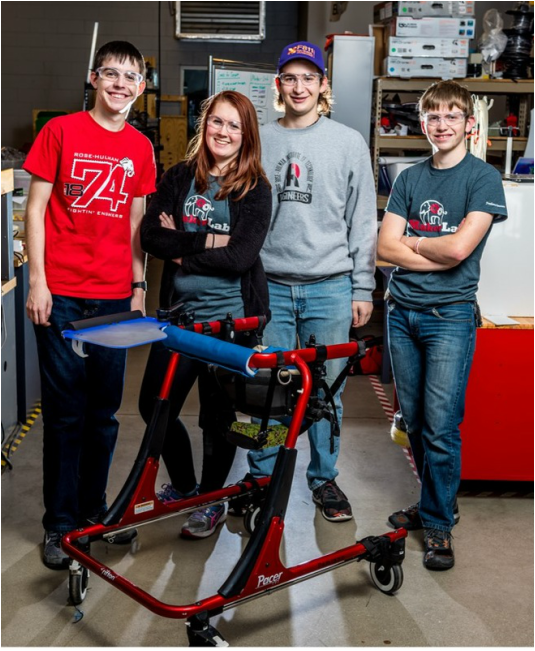
We met with local doctors who specialize in this kind of rehabilitation for children and decided to modify a Hart Walker. We adjusted and tuned it to be durable enough to last for many years, and safe and comfortable enough to guide him through therapy. We also made it adjustable so it could grow with him. The finished device was supportive and comfortable for both a five-year-old and an eighteen-year-old, and we added removable attachments that give less support as he gets stronger.
To round out the device, we worked with a team of physical therapists to produce a treatment plan for the boy's doctor and family. It explains what each part does, how to use it and what to do as he progresses.
Outcome
The project took ten weeks and more than 100 hours of work. The device was delivered around Christmas, and only a few months after it shipped he was almost walking again. At the time, the estimate was that he would be walking fully by December 2016, if not sooner.
The team
- Luke Gelfius, Electrical Engineer, class of 2019: design and development of the finished product
- Adam Czyzewski, Biomedical Engineer, class of 2019: mechanical fabrication
- Madison Muncie, Biochemistry, class of 2019: developed the rehabilitation plan and integrated it into the design
- Tim Balz, Mechanical Engineer, class of 2017: project lead, delivered the finished device to Moldova
In the media