Classical Theremin
Introduction
The theremin is an electronic instrument played without touching it. Two antennas control pitch and volume: the player's hand position relative to each antenna changes a capacitance, and that changes the sound. It is known for an eerie tone used in horror and sci-fi films and in 1960s music.
Over the years many designs have simplified the original circuit with microprocessors and IR proximity sensors. This project went the other way and explored a more traditional theremin built from traditional components.
The goal was a working, adaptable theremin that shows how different dielectrics and impedance values affect pitch and tone. We also wanted to compare base oscillator frequencies and change the shape and material of the antennas to see how each changes the tone.
How it works
The instrument uses three oscillators, each running at roughly 200 kHz depending on tuning. One is a reference oscillator, tuned with a potentiometer. The other two set pitch and volume, and each responds to the player's distance from its antenna, which acts as one plate of a variable capacitor. The pitch signal is scaled against the reference, which defines the available range of pitches. The volume oscillator works the same way for amplitude. The resulting signal passes through a series of filters and an audio amplifier before reaching the speaker.
Procedure
Over the ten-week quarter we built the theremin, made the adjustments it needed to become operational, and measured its frequencies at specific points. Those measurements became the baseline for the tests below.
Test 1: changing the dielectric
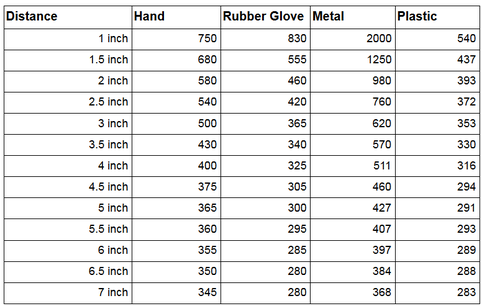
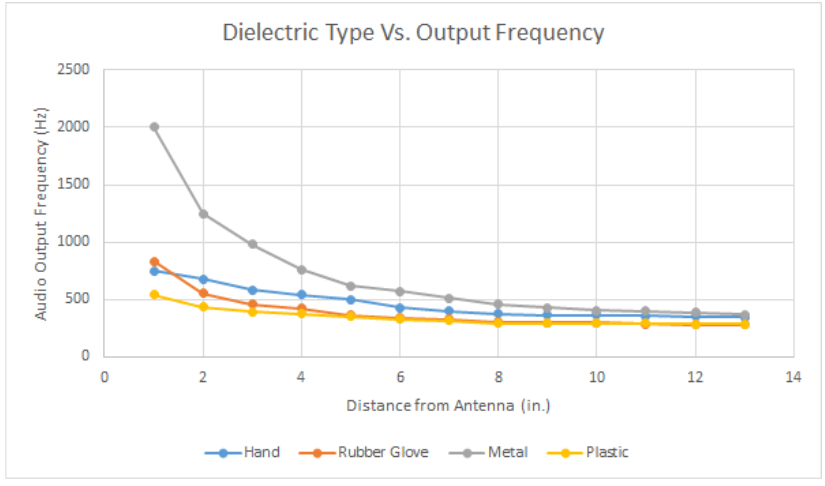
We replaced the bare hand with a rubber glove, a metal covering and a plastic covering. The hand acts as one side of a parallel-plate capacitor and the antenna as the other, so whatever covers the hand acts as a dielectric.
Hypothesis: as the material's conductivity goes up, the frequency of the variable pitch oscillator should go down, so the theremin's output frequency goes up.
Result: the plastic (low conductivity) gave a low frequency and the metal (high conductivity) gave a high frequency, as expected. The rubber glove surprised us: we expected a lower frequency than the bare hand and got a higher one, likely because of rubber's dielectric properties.
Test 2: changing the antenna
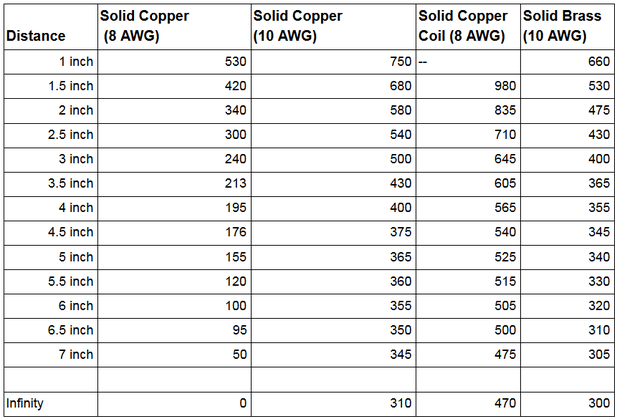
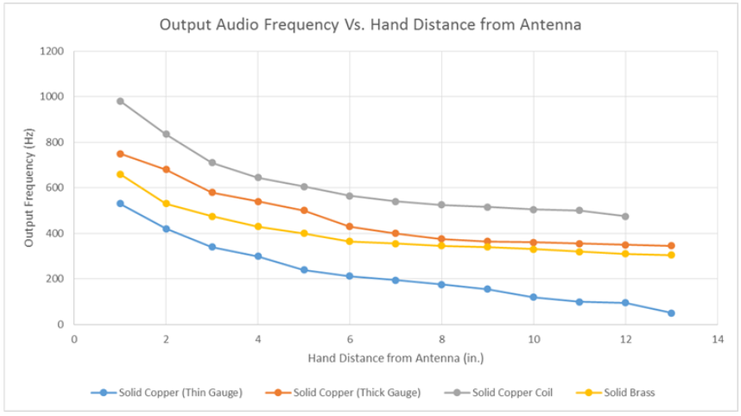
We swapped in antennas of different materials and shapes, varied the distance, recorded the output frequencies, and plotted frequency against distance for each.
Hypothesis: if the antenna's area increases, the oscillator frequency should decrease, which raises the theremin's output frequency.
Result: the results matched. Each antenna produced a similar characteristic curve, with the height of the curve changing with effective area. Copper and brass antennas had the same area, but the brass curve dropped off much faster than the copper one.
Tests we skipped
Early on we wondered how temperature and humidity would affect the instrument. After several samples the changes were insubstantial, so we dropped those tests. We also set aside a copper-clad steel antenna, because we wanted to focus on non-magnetic versus magnetic materials and already had comparable data.